
Managing multiple billing systems drains your team’s time and creates costly errors. Every invoice reconciliation, every manual data entry task, and every vendor management headache pulls focus from growing your business.
Unified billing for MSPs consolidates everything into one monthly statement, eliminating administrative chaos and giving you clear visibility into your cash flow. The right billing partner transforms how you operate, reducing overhead while strengthening client relationships.
The Hidden Cost of Fragmented Billing Systems
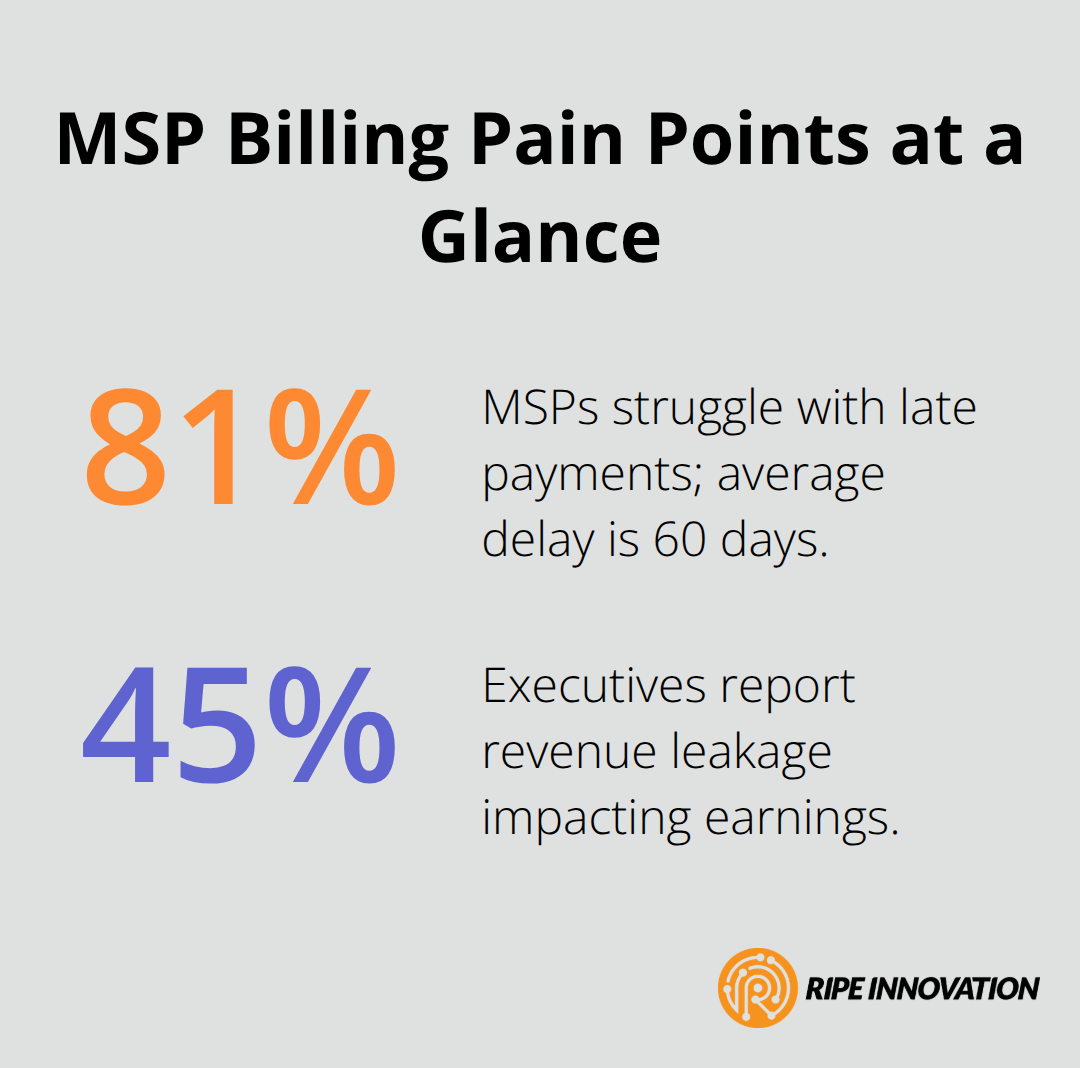
Multiple billing systems force your team into an endless cycle of manual reconciliation. When your PSA generates one invoice, your accounting software tracks another version, and your payment processor holds yet a third record, discrepancies emerge constantly. According to MSP Insights, 81% of MSPs struggle with late payments, with an average delay of 60 days-a direct consequence of invoicing chaos that confuses clients and delays collections. Each reconciliation consumes hours, and mistakes compound quickly. A single pricing error across systems can cost you thousands in lost revenue before anyone notices. Your team spends entire days matching records instead of serving clients or identifying growth opportunities.
The operational drag proves severe: administrative staff become invoice auditors rather than business contributors. When data lives in separate systems, you lose visibility into what you actually owe versus what clients owe you, making cash flow forecasting nearly impossible.
Where Revenue Actually Leaks Away
Revenue leakage in fragmented billing environments spreads widely and costs significantly. About 45% of executives report leakage in their organizations, according to BCG research, and that leakage translates into earnings reductions of 1–5% depending on your size and scope. Missed time entries, outdated pricing applied to the wrong clients, and duplicate or skipped invoices occur silently in multi-system environments. Your margins erode without clear visibility. Vendor management complexity compounds the problem: separate contracts with your PSA vendor, accounting software provider, and payment processor mean higher costs, fragmented support, and slower problem resolution. Each vendor operates independently, so when billing breaks, you navigate finger-pointing instead of solutions. Implementation timelines stretch across months due to complex data migrations and system reconciliations.
The Path Forward: Unified Billing
A unified approach eliminates these layers of waste immediately. The right billing partner consolidates everything into a single monthly statement, syncing data in real time across all touchpoints and removing the reconciliation burden entirely. This transformation requires evaluating which partner can truly integrate with your current stack and deliver the transparency your business demands.
How Unified Billing Transforms Your Operations
Eliminate Fragmented Workflows and Manual Reconciliation
Unified billing stops the fragmented workflow that consumes your team’s productive hours. When all services-managed IT, cloud subscriptions, software licenses, and usage-based charges-flow into a single monthly statement, your invoicing process shifts from reactive firefighting to automated execution. Real-time data synchronization between your PSA, accounting system, and payment processor means information flows once, not three times. Your billing team stops manually matching records across disconnected platforms and instead focuses on client relationships and revenue growth. A single source of truth for all customer data reduces errors dramatically: automated invoicing prevents the most common mistakes-missed time entries, outdated pricing applied to wrong clients, and duplicate or skipped invoices. Implementation timelines compress significantly when you choose a platform with native billing integration rather than bolted-on solutions requiring complex data migrations. Most unified platforms deploy in weeks, not months, because your data doesn’t need to move between incompatible systems.
Unlock Real-Time Cash Flow Visibility
Cash flow visibility transforms immediately when unified billing connects your invoicing directly to payment collection. Real-time tracking shows exactly which invoices remain outstanding, which clients typically pay early or late, and where collection bottlenecks exist. This visibility enables better forecasting: you know with precision what revenue arrives next week versus next month, allowing you to plan staffing, vendor payments, and growth investments with confidence. Automated payment reminders and branded client portals reduce your accounts receivable aging dramatically. Organizations that implement transparent client dashboards report significant improvements in AR aging and payment speed. When clients see transparent line items showing exactly what services they received during which period, they trust the invoice and pay faster.
Accelerate Collections and Free Working Capital
The financial impact proves immediate and measurable. Reducing your days sales outstanding through faster invoicing and automated collection frees working capital immediately. That freed capital funds growth without requiring external financing. Interactive client dashboards drive faster payments and enable a substantial portion of your client base to switch to AutoPay, further accelerating collections. Automated reminders save your team significant hours each month while late payments get collected faster. The combination of transparent invoicing, client self-service portals, and automated follow-ups creates a powerful engine for cash flow improvement. With this foundation in place, the next critical step involves selecting a billing partner whose integration capabilities and transparency align with your specific operational needs.
Selecting a Billing Partner That Actually Integrates
Map Your Technology Stack First
Your current tech stack determines whether a unified billing platform succeeds or creates new friction. Most MSPs operate within ConnectWise, HaloPSA, Autotask, or SuperOps for PSA management, then layer QuickBooks Online, Xero, or Sage for accounting, plus Stripe or PayPal for payments. A unified billing platform that doesn’t sync natively with these systems forces your team back into manual data entry, defeating the entire purpose of consolidation. Map your exact technology dependencies before evaluating any vendor: identify which PSA generates your billable hours, which accounting software owns your general ledger, and which payment processor handles your collections. Ask prospective vendors directly whether they offer native API integrations or pre-built connectors to each system. Avoid vendors who promise custom integration work-that means months of delays, higher costs, and ongoing maintenance headaches.
Verify Real-Time Data Synchronization
The best platforms sync data bidirectionally in real time, meaning changes in your PSA flow instantly to accounting and payment systems without manual intervention. Test this during the sales process by requesting a sandbox environment where you can verify actual data flow between your specific tools. Implementation timelines tell you everything: platforms with native billing integrated deploy in weeks, while solutions requiring data migrations stretch across months and introduce risk of data loss or corruption. Real-time synchronization eliminates the reconciliation burden that consumes your team’s productive hours and prevents the most common mistakes-missed time entries, outdated pricing applied to wrong clients, and duplicate or skipped invoices.
Demand Pricing Flexibility and Transparency
Transparency in pricing and flexibility in service packaging separate vendors who understand MSP billing from those selling generic solutions. MSPs bill across flat monthly retainers, per-user subscriptions, per-device charges, hourly labor, usage-based consumption, and hybrid arrangements within the same client relationship. Your billing platform must support all these models simultaneously without forcing workarounds. Ask the vendor how they handle a client who pays a flat monthly fee for managed IT, a per-user cost for Microsoft 365, usage-based charges for cloud backup, and a project milestone invoice for network redesign-all on a single consolidated statement. Their answer reveals whether they’ve solved real MSP complexity or oversimplified their solution. Pricing flexibility also means supporting tiered discounts for volume, enterprise-specific rates that differ from your standard pricing, and mid-cycle changes when clients add or remove services. Strong vendors provide audit-ready reporting that shows exactly how each charge calculated, which prevents client disputes and protects your margins.
Evaluate Support Quality and Reliability
Billing problems directly impact cash flow, so you need vendor responsiveness measured in hours, not days. Request references from MSPs of similar size and ask specifically about response times when invoicing breaks. Service level agreements should guarantee uptime targets above 99.5% and define escalation paths for critical issues affecting collections. Support quality separates vendors who stand behind their platforms from those who disappear after implementation. Evaluate whether the vendor offers dedicated account management, proactive monitoring of your billing health, and clear communication channels for urgent issues. The vendor you select becomes a critical partner in your revenue operations, so their commitment to your success matters as much as their technical capabilities.
Final Thoughts
Unified billing for MSPs eliminates the operational chaos that drains your team’s time and erodes your margins. Consolidating all services into a single monthly statement delivers real-time visibility into cash flow, reduces administrative overhead, and strengthens client relationships through transparent invoicing. The financial impact proves measurable: faster collections, reduced accounts receivable aging, and freed working capital that funds growth without external financing.
Three concrete steps guide your transition to unified billing. First, audit your current technology stack and identify which PSA, accounting software, and payment processor you depend on-this clarity ensures you select a billing partner with native integrations rather than custom workarounds that delay implementation. Second, evaluate prospective vendors through sandbox access to verify real-time data synchronization between your specific tools and confirm they handle your exact billing complexity across flat retainers, per-user charges, usage-based consumption, and project invoices. Third, confirm that the vendor offers pricing flexibility, audit-ready reporting, and support quality measured in hours rather than days, since billing problems directly impact your cash flow.
Implementation timelines compress significantly when you choose a platform with native billing integration, with most unified solutions deploying in weeks rather than months. Start with one client segment or service type to validate the process, then expand gradually to more complex scenarios. Schedule a demo with your prospective billing partner to explore how their platform integrates with your current stack, handles your specific pricing models, and delivers the transparency your business demands.