
Remote work is here to stay, and MSPs who haven’t yet built a cloud desktop reseller program are missing significant revenue opportunities. The shift toward flexible work arrangements has created genuine demand from businesses of all sizes.
At RIPE INNOVATION INC., we’ve seen firsthand how MSPs scale their offerings by moving beyond traditional infrastructure. This guide walks you through the strategies that work.
Why Cloud Desktop Demand Is Accelerating
Remote work has moved from temporary necessity to permanent business model, and clients actively seek ways to support distributed teams without maintaining expensive on-premises infrastructure. According to Omdia, the managed services market grows only about 10% in 2026, which means MSPs who stick with traditional per-user services face margin compression. Cloud desktop reseller programs change this equation entirely.
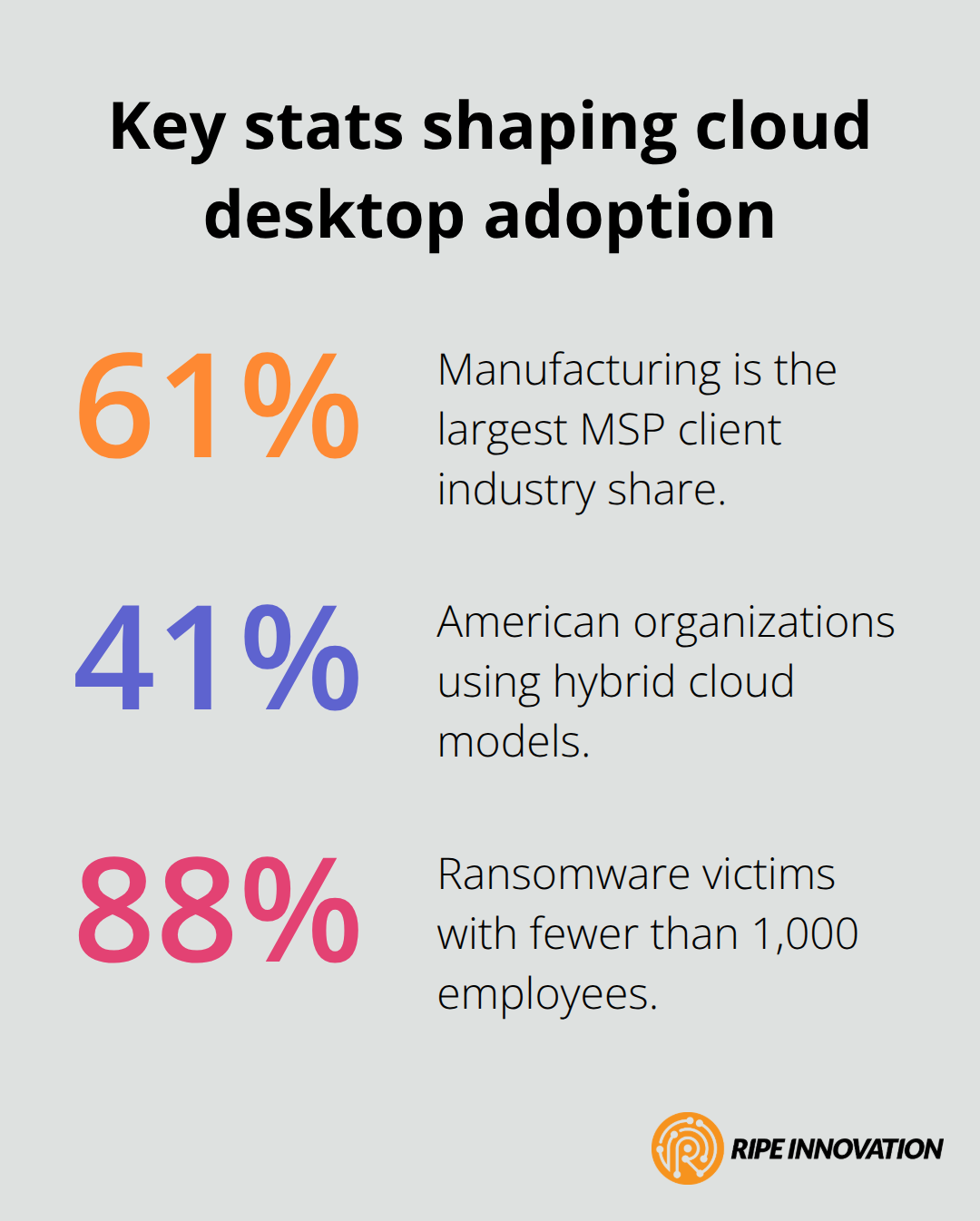
The global managed security services market will rise significantly, and cloud desktop integrates naturally with these security-first offerings. Manufacturing represents the largest MSP client industry at 61%, and these organizations need scalable desktop solutions to support hybrid teams across multiple locations.
The Financial Case Is Straightforward
Clients abandon on-premises infrastructure because the math no longer works. Capital expenditures for servers, licensing, and ongoing hardware maintenance create unpredictable costs, while cloud desktop replaces these with predictable monthly subscriptions. A manufacturing facility with 50 users no longer needs a dedicated IT person managing desktops locally; instead, they scale users up during peak seasons and down afterward, paying only for what they use. The U.S. MSP market will reach $116.25 billion by 2030, and cloud desktop drives much of this growth. MSPs who offer cloud desktop achieve margins of 50–70% while owning the customer relationship and building brand equity. This differs fundamentally from commodity hardware sales. Cloud desktop also eliminates the support burden of managing physical endpoints across multiple sites, which translates directly to lower service delivery costs for MSPs.
Complexity Drops When Infrastructure Moves to the Cloud
On-premises desktop management requires constant attention: Windows updates, driver conflicts, hardware failures, and security patches consume technician time. Cloud desktop centralizes this burden. Deployments happen in minutes through self-service provisioning, and scaling to new offices requires only internet connectivity. Approximately 2 in 5 ransomware attacks in Q4 2024 targeted companies with between 101 and 1,000 employees, and cloud desktop inherently improves security posture through centralized identity management, threat monitoring, and backup integration. MSPs who bundle cloud desktop with managed security services position themselves as strategic advisors rather than break-fix providers. This shift in perception justifies higher margins and improves client retention.
Meeting Hybrid Infrastructure Expectations
Hybrid cloud adoption is common, with 41% of American organizations using hybrid models, which means clients want flexibility without complete infrastructure overhaul. Cloud desktop platforms support this reality (integrating with existing on-premises systems while delivering modern capabilities like real-time transcription and AI-powered analytics through unified communications services). This hybrid approach lets clients maintain legacy systems where necessary while modernizing their desktop environment. The ability to support both cloud computing and on-premises workloads simultaneously positions MSPs as partners who understand real-world constraints rather than vendors pushing wholesale replacement. Organizations that operate across multiple locations and regulatory environments particularly value this flexibility.
As you evaluate cloud desktop opportunities within your own client base, the next step involves selecting the right platform and partner to build your reseller program on.
How to Build Your Cloud Desktop Program Without Getting Stuck
Select a Platform Partner Built for Growth
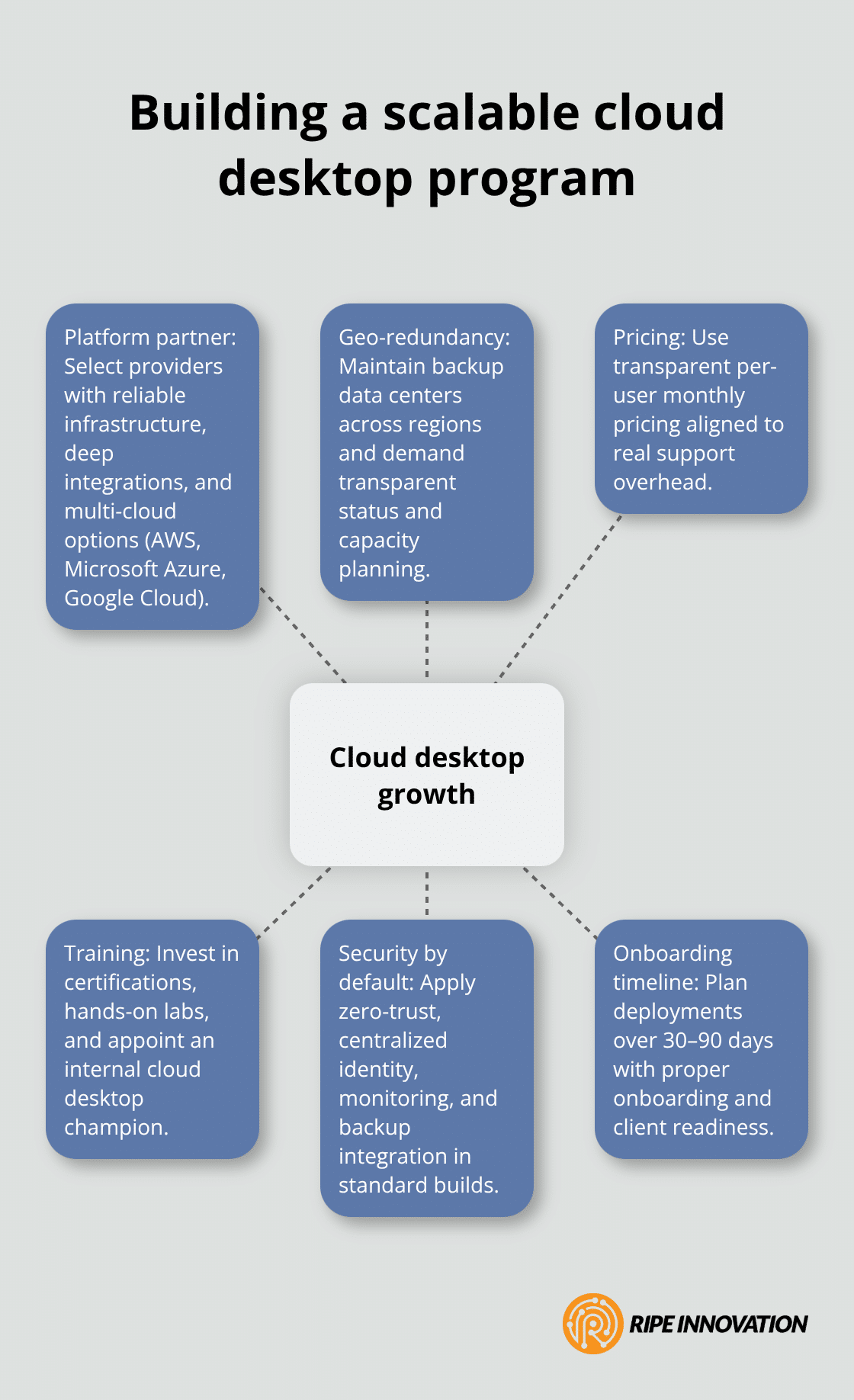
The right platform partner determines whether your cloud desktop reseller program thrives or stalls. The decision involves more than comparing feature lists; it requires evaluating infrastructure reliability, integration depth, and whether the partner actively supports your growth. Look for providers with proven experience across major platforms like AWS, Microsoft Azure, and Google Cloud, since your clients will inevitably ask about multi-cloud flexibility. Geo-redundancy matters significantly-your platform should maintain backup data centers across different regions so a single outage doesn’t cascade into client downtime. Request transparent status pages and capacity planning documentation before committing.
During evaluation, test how quickly you can provision a desktop environment and whether self-service capabilities exist for your clients. Pricing structure should be transparent with no hidden fees; many MSPs waste months trying to understand margin calculations after signing. Deployment timelines typically run 30–90 days with proper onboarding, so factor this into your go-to-market planning.
Structure Pricing for Sustainable Margins
Pricing models directly impact whether recurring revenue actually materializes or evaporates through customer churn. Most successful MSPs structure cloud desktop pricing as a per-user monthly fee rather than fixed capacity bundles, since this aligns cost with actual client usage and removes the barrier to adoption. Typical margins of 50–70% are achievable when you layer cloud desktop with managed security services, but only if your cost structure accounts for support overhead.
Calculate your actual support costs by tracking hours spent on cloud desktop clients for the first 90 days, then build pricing that reflects this reality rather than industry averages. Many MSPs underprice initially hoping to gain volume, then discover they cannot profitably serve those clients. Avoid this trap by pricing for your real cost structure from day one.
Train Your Team to Deliver Consultative Service
Training your team transforms cloud desktop from a technical offering into a consultative service that justifies premium pricing. Invest in formal certification programs through your platform provider; most offer structured training that covers deployment, troubleshooting, and optimization. Your first-line support staff need hands-on lab experience before handling client issues, not just video training.
Assign one team member as the cloud desktop champion who stays current on platform updates and attends quarterly partner webinars; this person becomes your internal expert and improves response times significantly. Document your standard deployment workflow and create pre-configured desktop images that accelerate onboarding-this reduces deployment time from weeks to days and improves consistency across clients.
Build Security Into Your Standard Deployments
Security hardening should be non-negotiable in your standard builds; zero-trust principles applied during initial deployment prevent security issues that cost far more to remediate later. Ransomware attacks targeting companies 101 to 1000 employees increased significantly in 2024, and cloud desktop inherently improves security posture through centralized identity management, threat monitoring, and backup integration. When you bundle cloud desktop with managed security services, you position yourself as a strategic advisor rather than a break-fix provider.
This shift in perception justifies higher margins and improves client retention. Your clients gain confidence knowing that desktop security, backup, and threat detection operate as an integrated system rather than disconnected tools. With these foundational elements in place, you’re ready to identify which clients represent the best opportunities for migration.
Marketing and Selling Cloud Desktop to Your Clients
Identifying Your Highest-Probability Prospects
Manufacturing companies with 50 to 200 employees represent your strongest cloud desktop prospects. Manufacturing is the largest MSP client industry at 61%, and these businesses operate across multiple shifts and locations where on-premises desktop management becomes administratively expensive. Target facilities that currently employ a dedicated IT person managing local desktops; that single person often becomes your strongest internal advocate because cloud desktop eliminates their most time-consuming tasks.
Professional services firms (accounting, engineering, consulting) with hybrid workforces rank equally high because they need consistent desktop experiences across office, home, and client sites. Ask your existing clients which departments struggle most with remote access or which locations consume the most IT support time; these pain points convert into migration opportunities faster than generic pitches about modernization. Avoid early-stage startups and micro-businesses under 20 employees who lack the IT infrastructure maturity to appreciate cloud desktop value. Instead, focus on established businesses with documented IT spend, multiple locations, and documented security concerns. A manufacturing plant that experienced even a minor ransomware scare in the past 18 months becomes an exceptionally qualified prospect because they understand that centralized security, automated backups, and threat detection matter.
Presenting Cost Reduction to Finance Leaders
Finance executives and operations directors make cloud desktop purchasing decisions, not IT managers, which means your pitch must lead with cost reduction and operational efficiency rather than technical features. Calculate the prospect’s actual annual cost of on-premises desktop management by adding hardware replacement cycles (typically five years), technician labor for support and updates, licensing costs, and security patching overhead. A manufacturing facility with 50 users spending 15 hours weekly on desktop management tasks pays roughly $40,000 annually in hidden IT labor alone.
Cloud desktop reduces this to approximately 3 hours weekly through automation and centralized management, immediately freeing 600 hours annually that technicians redirect toward higher-value work. Present this calculation in your initial conversation; most prospects have never quantified this cost because it hides across multiple budget lines.
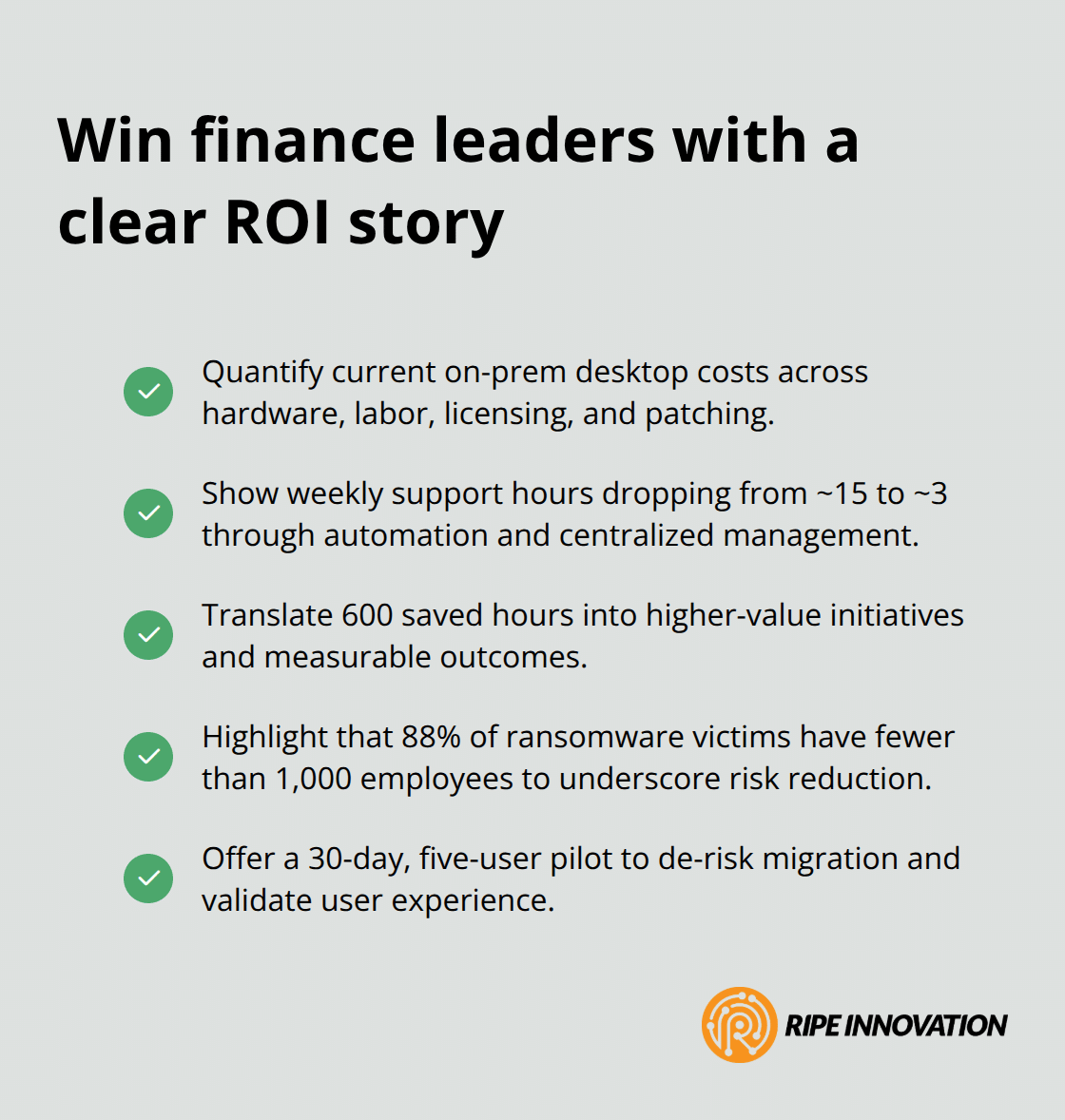
Sophos reported that 88% of ransomware victims are organizations with fewer than 1,000 employees, making security a legitimate business risk for your target market. Frame cloud desktop not as a technology upgrade but as a control mechanism that reduces ransomware exposure through centralized identity management, mandatory encryption, and immutable backups.
Addressing Security and Uptime Concerns
Manufacturing clients particularly respond to uptime guarantees; cloud desktop eliminates single-point failures that occur when a local server fails or a technician leaves unexpectedly. Security concerns from IT directors stem from legitimate questions about data residency, compliance, and backup integrity. Address these directly by providing your platform partner’s SOC 2 certification documentation and demonstrating your backup and disaster recovery processes in detail.
Executives worry about vendor lock-in, particularly if they’ve experienced painful migrations in the past. Counter this by explaining that cloud desktop operates independently from other services; clients can migrate away without losing their messaging, file storage, or security infrastructure. Offer a 30-day pilot period with five users to let prospects experience the actual deployment speed and user experience before committing to full migration; this removes perceived risk and typically accelerates decision timelines from months to weeks.
Overcoming Cost and Resistance Objections
Cost concerns dominate early conversations, but they’re often a symptom of poor ROI communication rather than genuine budget constraints. When a prospect claims they cannot afford cloud desktop, ask specifically what they’re comparing it against. Most assume cloud desktop costs more than current spending because they underestimate their on-premises expenses. Walk them through the actual calculation using their own numbers; prospects almost always discover their current model costs more than they realized.
The most damaging objection surfaces when IT staff resist cloud desktop because they fear losing influence or job security. Reframe cloud desktop as a tool that shifts IT’s role from break-fix technician to strategic advisor who manages security, optimization, and integration with business applications. Prospects who understand this distinction become internal champions rather than obstacles.
Final Thoughts
Three concrete commitments separate successful cloud desktop resellers from those who stall: select a platform partner with proven infrastructure reliability, structure pricing that reflects your actual support costs, and train your team to deliver consultative service rather than commodity offerings. MSPs who execute these fundamentals achieve 50–70% margins while building genuine customer relationships that reduce churn. The U.S. MSP market reaches $116.25 billion by 2030, and cloud desktop drives significant growth within this expansion.
Identify five qualified prospects from your existing client base-manufacturing facilities with multiple locations, professional services firms with hybrid workforces, or any organization currently spending more than $30,000 annually on desktop management. Calculate their actual on-premises costs using the framework provided earlier, then schedule conversations with finance leaders rather than IT staff. Most prospects discover their current model costs substantially more than they realized once you walk through the actual numbers.
Start with a 30-day pilot using five users to remove perceived risk and accelerate decision timelines (deployment typically runs 30–90 days with proper onboarding). We at RIPE INNOVATION INC. support cloud desktop resellers with enterprise-grade infrastructure, transparent pricing, and dedicated technical support so you can focus on growing your business. Visit RIPE INNOVATION INC. to explore how we eliminate complexity with flexible partnerships and single monthly billing.