
Managing multiple vendor invoices every month drains your team’s time and makes cash flow predictions nearly impossible. At RIPE INNOVATION INC., we’ve seen MSPs lose thousands in administrative costs just trying to track separate billing cycles.
Single monthly billing consolidates everything into one predictable payment schedule. This shift transforms how you manage finances and frees your team to focus on what actually grows your business.
Why Multiple Billing Cycles Drain Your Time and Cash Flow
The Hidden Cost of Staggered Vendor Payments
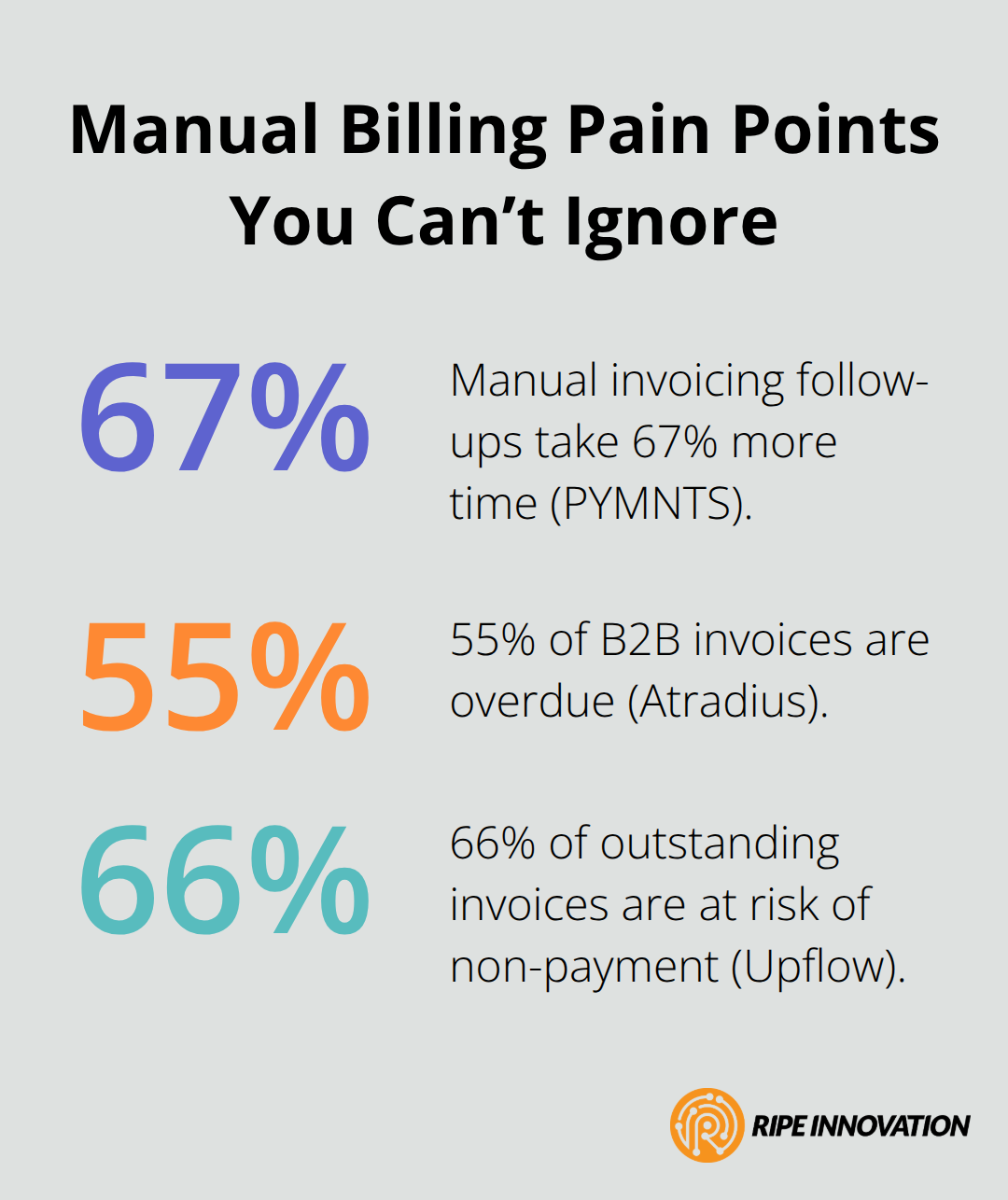
Most MSPs juggle three to five vendor invoices every month, each arriving on different dates with different payment terms. One vendor bills on the 5th, another on the 15th, a third on the 25th. Your accounting team spends hours matching invoices to contracts, reconciling discrepancies, and tracking what’s actually been paid. According to PYMNTS, manual invoicing and payment processes take 67% more time to follow up on overdue payments. That’s not just inefficiency-that’s money sitting in accounts receivable longer than it needs to.
When you’re running an MSP with tight margins, every day an invoice sits unpaid affects your ability to pay your own vendors on time, creating a ripple effect through your cash flow. The real cost isn’t just the hours your team spends on billing; it’s the visibility you lose. Without a unified billing view, you can’t forecast accurately. You don’t know whether cash will be tight next month because vendors are staggered across the calendar.
Why Fragmented Billing Kills Forecasting and Client Trust
You can’t bundle charges for clients or negotiate better terms with vendors when you manage separate contracts with different renewal dates. The administrative burden gets worse as you scale. A $2M MSP losing 5% to 15% of annual revenue to billing inefficiencies means $100,000 to $300,000 in earned revenue never gets collected. Atradius reports that 55% of all B2B invoices are overdue, and that’s partly because fragmented billing systems make it harder to track what’s owed and follow up consistently.
You end up with duplicate work-entering the same client data into your PSA, then again into your accounting software, then manually cross-checking both. Deloitte found that 48% of B2B customers are frustrated by unclear pricing information, and when your invoices arrive at random intervals with inconsistent formatting, your clients feel that frustration too. They don’t understand why they’re getting billed separately for hosting one month and bundled with other services the next.
How Single Monthly Billing Transforms Your Operations
Single monthly billing eliminates this chaos. It consolidates vendor payments into one predictable date, gives your accounting team one reconciliation cycle instead of five, and lets you show clients a clear, consistent invoice every month. This shift also positions you to implement the billing automation and vendor consolidation strategies that separate high-performing MSPs from those stuck in manual processes.
What Happens to Your Cash Flow When Billing Consolidates
Visibility Transforms Unpredictable Cash Flow Into Measurable Reality
Single monthly billing transforms your cash flow from unpredictable to measurable. Instead of tracking five vendor invoices scattered across the calendar, you know exactly when money moves in and out. This visibility lets you plan ahead. Consolidating to one monthly cycle recovers money faster by eliminating the revenue leakage that happens when invoices get missed, duplicated, or reconciled incorrectly across disconnected systems.
Accounting Overhead Drops When You Run One Reconciliation Cycle
Cash flow improves within the first month because you no longer chase overdue invoices scattered across different vendor payment terms. Your accounting team stops spending hours matching invoices to contracts. Instead of five reconciliation cycles, you run one. That alone cuts accounting overhead by roughly 20% to 30%, depending on your current manual processes. Faster invoice processing means faster payment collection.
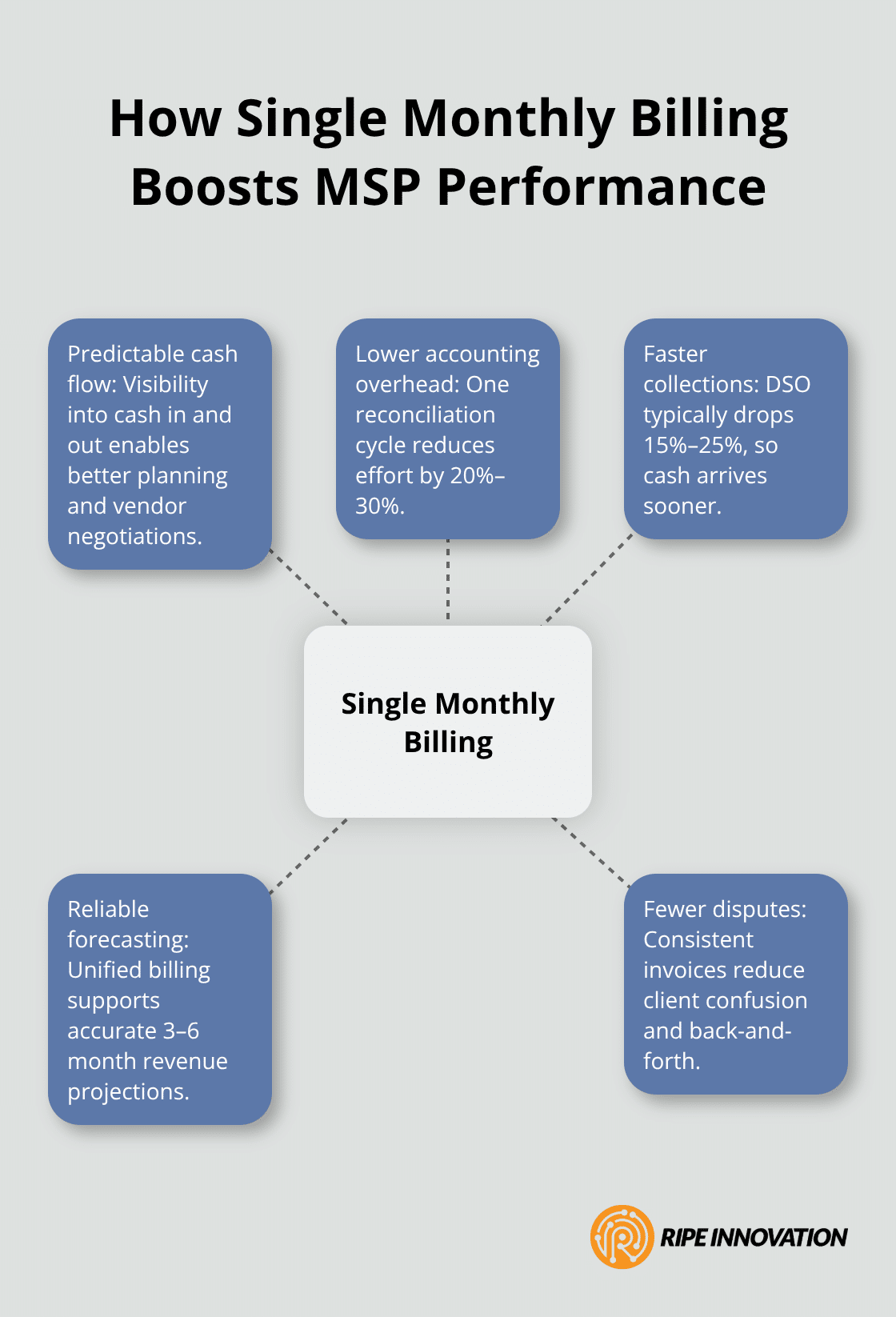
MSPs that move to single monthly billing typically see Days Sales Outstanding drop by 15% to 25%, which means cash lands in your account sooner.
Upflow research shows that 66% of outstanding invoices are at risk of non-payment, but when you consolidate billing and send invoices on a predictable schedule, clients know exactly what to expect and when to pay. This consistency reduces the friction that causes late payments.
Forecasting Becomes Reliable Once You Consolidate
Forecasting becomes reliable once you consolidate. You can predict revenue and expenses three to six months out because billing no longer varies by vendor. This stability lets you negotiate better terms with vendors because you’re now a consolidated account instead of five scattered contracts. You gain visibility into which services are actually profitable. When hosting, domains, and other recurring items flow through one monthly invoice instead of random pass-throughs or manual spreadsheet entries, you can finally see which clients generate healthy margins and which ones drain resources.
Circuit Saviors, a Modesto MSP, achieved roughly 30% more efficiency by integrating their PSA with billing automation and saved 16 hours per month. That time savings translates directly to margin improvement because your team focuses on delivery instead of invoice chasing.
Disputes Shrink When Clients See Consistent, Clear Charges
Single monthly billing also reduces the dispute costs that plague fragmented systems. Consolidating to one invoice per client per month means fewer disputes because clients see consistent, clear charges instead of random invoices appearing throughout the month. This predictability strengthens client relationships and frees your team from constant back-and-forth explanations about why charges appear when they do.
With consolidated billing in place, you’re ready to implement the automation and vendor strategies that lock in these gains and position your MSP for sustainable growth.
Moving From Chaos to Clarity
Map Your Current Vendor Contracts
The transition to single monthly billing requires three concrete actions. First, map every vendor contract you currently manage and note the billing date, payment terms, and renewal schedule for each one. This audit takes a few hours but reveals patterns you’ve probably missed. You’ll likely find that vendors bill on random dates because you never negotiated a specific cycle when you signed up.
Consolidate Billing Dates With Your Vendors
Second, contact your top five vendors and propose consolidating to a single billing date that works for your cash flow cycle. Most vendors will agree because consolidated accounts are easier for them to manage too. Circuit Saviors negotiated consolidated billing with their vendors and freed up 16 hours per month that their accounting team had spent chasing scattered invoices. When you approach vendors with a clear consolidation plan, you position yourself to negotiate better payment terms at the same time.
Implement Billing Software That Syncs Automatically
Third, implement billing software that pulls data directly from your PSA and accounting tools so charges flow automatically into one monthly invoice instead of requiring manual entry across disconnected systems. The 2023 Global Managed Security Survey found that 32% of MSPs struggle with integrating PSA and accounting tools, which is exactly why single monthly billing fails without the right software backbone. Your billing platform must sync device counts from your RMM, usage data from your systems, and ticket closures from your PSA so nothing gets missed and everything lands on one invoice automatically.
Execute a Phased Rollout Across Client Segments
TAZ Networks saved roughly 30% of invoicing time by moving to automated billing and reduced their accounts receivable aging by four times over, which meant cash landed in their account far sooner.
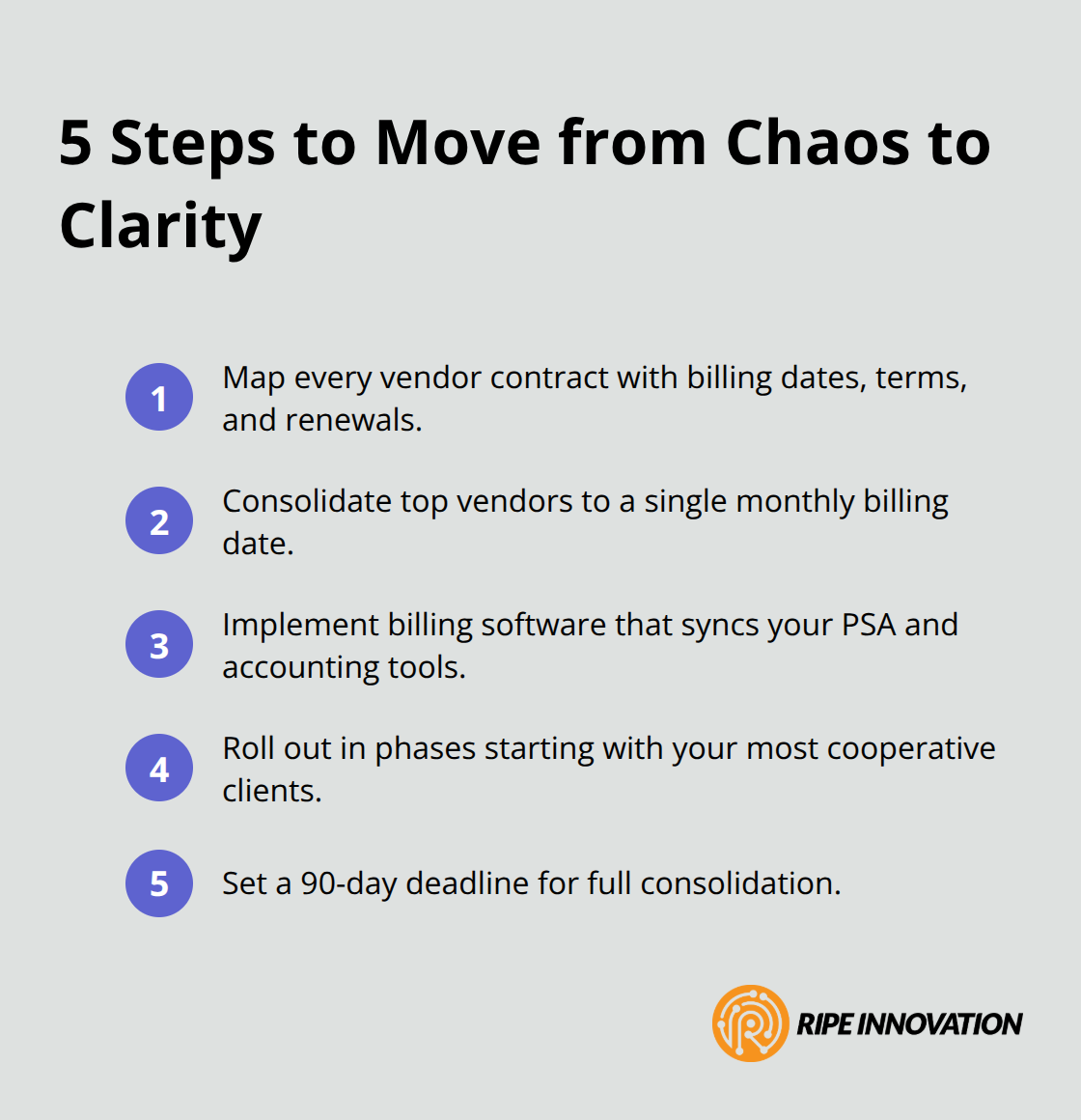
Start with your most cooperative clients first, not your most complex ones. Run the new billing cycle on those accounts for one month, verify the accuracy, then expand to other client segments. This phased approach lets your team build confidence with the process before scaling it across your entire client base.
Set a Hard Deadline for Full Consolidation
Set a hard deadline for consolidation within 90 days so the project doesn’t drift. MSPs that treat this as an ongoing initiative rather than a project tend to abandon it halfway through when operational pressures mount. A consolidated billing structure (one invoice per client per month) combined with automated software creates the foundation for sustainable growth.
Final Thoughts
Single monthly billing transforms your operations from chaotic to predictable. Your team stops chasing scattered invoices across the calendar and starts focusing on client delivery instead. Consolidated billing reduces your accounting overhead by 20% to 30%, accelerates cash collection by 15% to 25%, and gives you the visibility to forecast revenue accurately three to six months ahead.
Your clients notice the difference too. Consistent, predictable invoices every month build trust and eliminate the confusion that causes disputes. Vendors recognize you as a consolidated account worth better terms. These operational gains compound as you scale, turning a $2M MSP’s 5% revenue recovery into $100,000 annually-money that funds growth and strengthens your margins.
Audit your vendor contracts today, consolidate billing dates with your top vendors, and implement software that syncs your PSA and accounting systems automatically. Start with a pilot group of clients, verify accuracy, then expand across your entire base. We at RIPE INNOVATION INC. help MSPs build billing foundations that support sustainable growth without manual overhead, and your future cash flow depends on the decisions you make now.