
For MSPs managing multiple clients, security threats evolve faster than traditional defenses can respond. Security alerts monitoring enables you to detect and neutralize threats before they cause damage.
The difference between a contained incident and a costly breach often comes down to speed. This guide walks you through establishing proactive monitoring strategies that protect your clients and strengthen your reputation.
Why Security Alerts Matter for MSPs
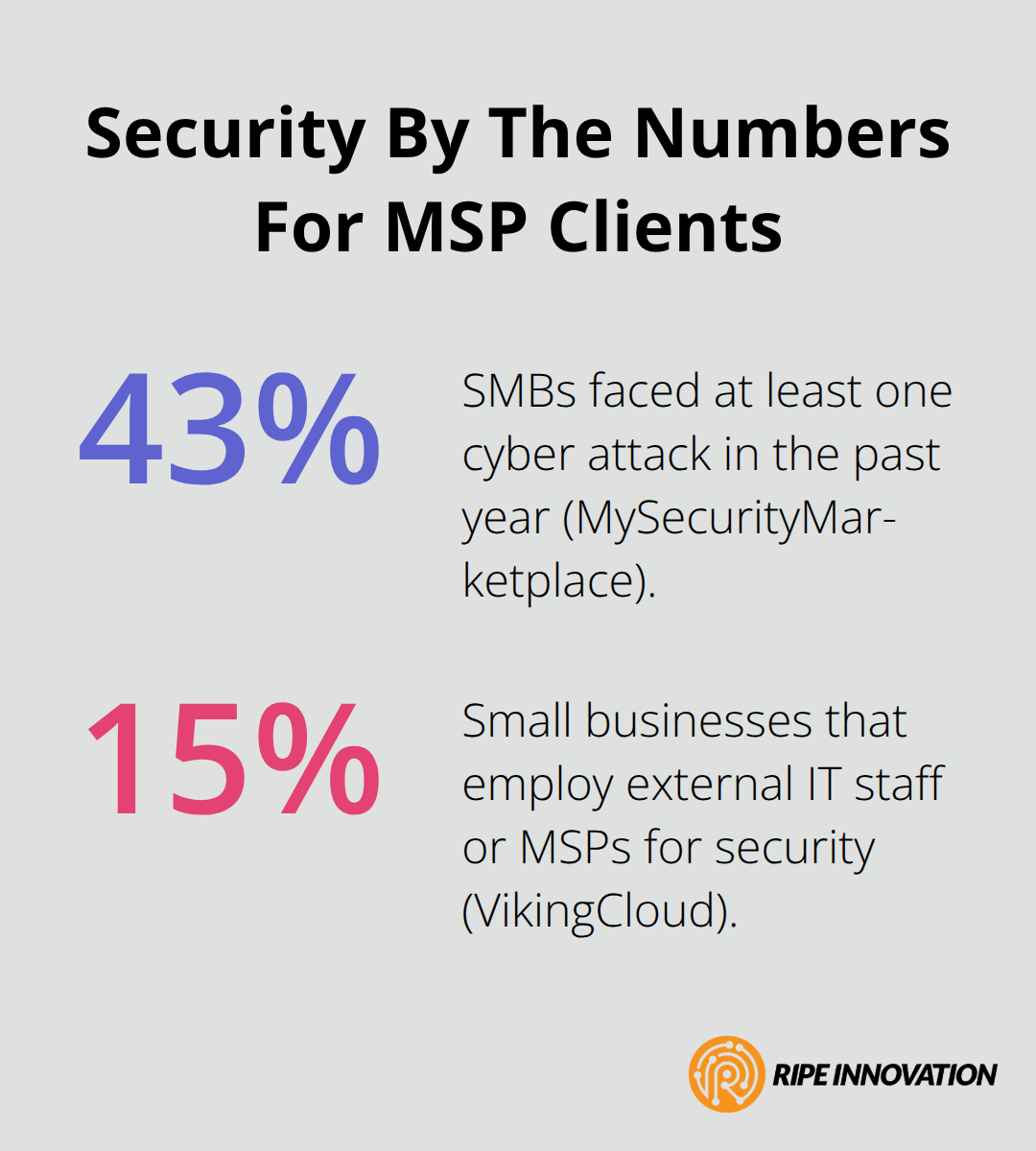
The statistics tell a sobering story. According to MySecurityMarketplace research, 43% of small and medium-sized businesses faced at least one cyber attack in the past year. Yet the real damage often depends not on whether an attack happens, but on how quickly you detect and respond to it. Organizations that identify breaches within days rather than months face dramatically lower costs and reduced operational disruption.
For MSPs, this speed advantage becomes your competitive edge and your clients’ lifeline.
Speed Changes Everything
The average dwell time-how long attackers remain undetected in a network-directly correlates with breach severity. When your monitoring systems catch threats in hours instead of weeks, you prevent attackers from moving laterally through systems, exfiltrating data, or deploying ransomware. Real-time alerts transform your role from incident responder to incident preventer. You stop threats before they escalate into the costly incidents that force small businesses to shut down. One in five US small businesses would go out of business if an attack cost just £7,500 (according to VikingCloud research), making your rapid response capability essential to client survival.
Trust Becomes Revenue
Your clients need proof that their security receives active monitoring, not passive protection. Continuous alert monitoring demonstrates vigilance and accountability. When you report on detected and blocked threats, you show measurable value. This builds the trust that justifies ongoing security investments and differentiates you from competitors offering only static defenses. Clients increasingly expect security partners to maintain 24/7 visibility, and only 15% of small businesses currently employ external IT staff or managed service providers to oversee their security (according to VikingCloud data). This gap represents your opportunity to establish yourself as the trusted security authority. Additionally, documented threat detection and response activities support regulatory compliance requirements under frameworks like GDPR. When you maintain records of detected threats and containment actions, you provide clients with the evidence needed for audits and compliance reviews, strengthening their confidence in your security posture management.
Moving Forward with Monitoring Strategy
Effective alert monitoring requires more than tools-it demands strategy. The next section explores the best practices that transform raw security data into actionable intelligence, helping you and your team respond faster and smarter to every threat your clients face.
How to Stop Alert Fatigue Before It Stops Your Response
The harsh reality facing most MSPs is this: too many alerts kill response effectiveness. A typical security infrastructure generates thousands of daily alerts, yet studies show that alert fatigue causes analysts to miss genuine threats while wasting hours on false positives. The problem isn’t the volume of data-it’s the lack of intelligent filtering. Your first priority must be establishing alert thresholds that separate signal from noise.
Tune Detection Systems to Each Client’s Environment
You must tune your detection systems to your clients’ specific environments rather than accepting default configurations. A financial services firm and a retail operation face completely different threat landscapes, yet many MSPs apply identical alert rules across all clients. This approach guarantees both over-alerting and under-detection. Start by understanding each client’s asset criticality, normal traffic patterns, and business operations. Then configure thresholds that trigger only when genuinely suspicious activity occurs. A failed login attempt at 2 AM from an unusual geographic location matters far more than routine failed password entries during business hours. Tenable and Qualys, the leading vulnerability management platforms, both provide dashboards that help you contextualize alerts by severity and asset importance. Use these insights to set rules that reflect actual risk rather than theoretical possibility.
Standardize Alert Categories and Escalation Paths
Many MSPs make the mistake of centralizing monitoring without centralizing intelligence. You can aggregate logs from a dozen clients into one SIEM platform, but if each client’s alerts follow different severity ratings and escalation procedures, your team will struggle to respond consistently. Standardize your alert categories across all clients, establish clear escalation paths, and document which alerts require immediate action versus scheduled review.
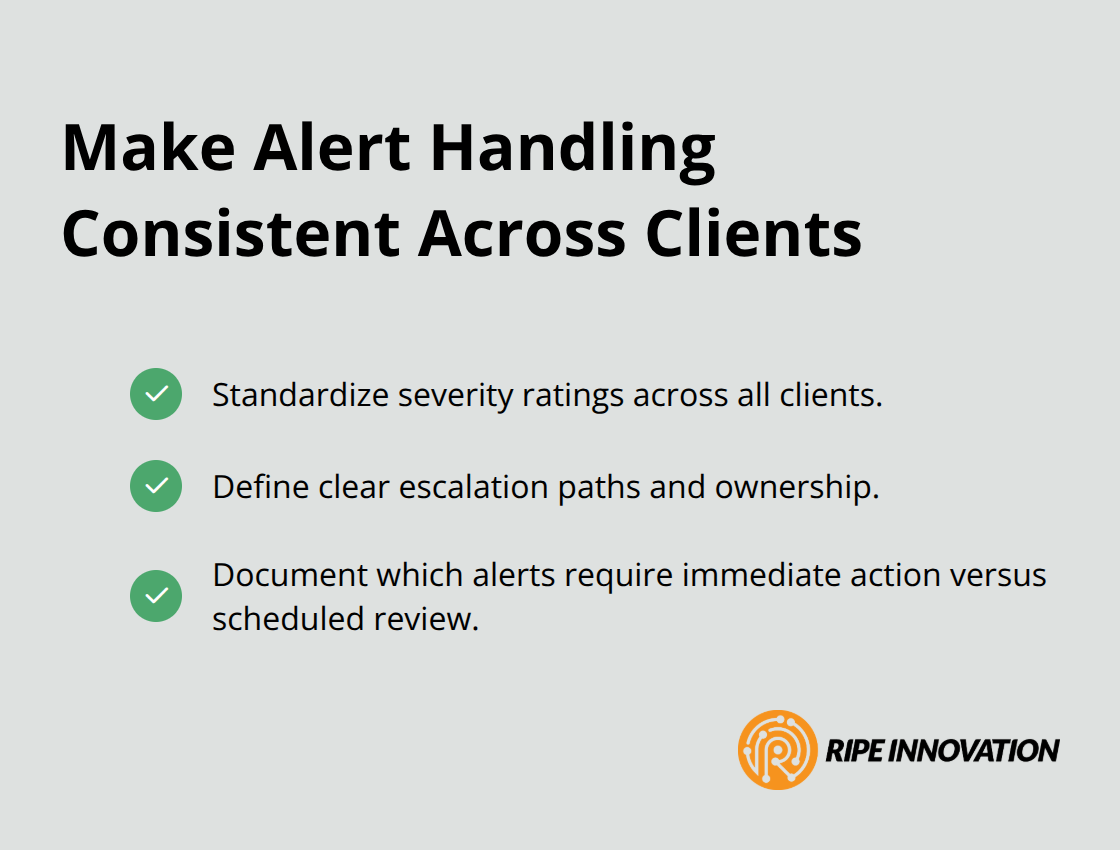
This consistency transforms monitoring from chaotic reactive firefighting into predictable, manageable operations.
Automate Enrichment and Ticket Creation
Automation separates thriving MSPs from overwhelmed ones. Every alert that requires manual intervention creates a bottleneck. Your team should handle enrichment, routing, and ticket creation automatically, reserving human expertise for actual threat analysis and containment decisions. When an alert arrives in your SIEM, automated workflows should immediately check whether the flagged IP address is known malicious, whether the user account has legitimate reasons for unusual access patterns, and whether the affected asset is business-critical. Only after enrichment should the alert reach an analyst’s queue, pre-sorted by genuine severity. This approach reduces triage time from hours to minutes.
Integrate Security Tools with Your ITSM System
Integration between your security tools and your ITSM system determines whether alerts disappear into forgotten tickets or drive rapid response. Freshservice and HaloPSA offer simpler, more maintainable alternatives to complex platforms like ServiceNow that often create technical debt through over-customization. Your goal is end-to-end visibility: every alert tracked from detection through resolution, with no blind spots where threats hide in administrative limbo. ConnectWise Manage and Automate provide solid automation capabilities within security workflows, allowing you to build containment steps directly into runbooks. When ransomware signatures trigger, automated processes should isolate the affected endpoint, block command-and-control communications, and alert your team simultaneously rather than waiting for manual intervention. This parallel execution of detection and containment dramatically reduces dwell time and damage.
Refine Your Monitoring System Continuously
The most effective MSPs treat alert management as a continuous discipline rather than a one-time configuration exercise. False positives undermine productivity, so regularly review which alerts generated tickets that led nowhere, then adjust detection rules accordingly. Set threshold rules that suppress known benign activity and use automatic suppression for alerts you’ve verified as noise. This iterative refinement ensures your monitoring system becomes smarter and more efficient every month. As your detection capabilities mature and your team gains experience with each client’s unique risk profile, you’ll discover that the real power of alert monitoring lies not in catching every possible threat, but in catching the threats that matter most-the ones that could actually harm your clients’ operations.
Which Tools Actually Deliver Alert Management at Scale
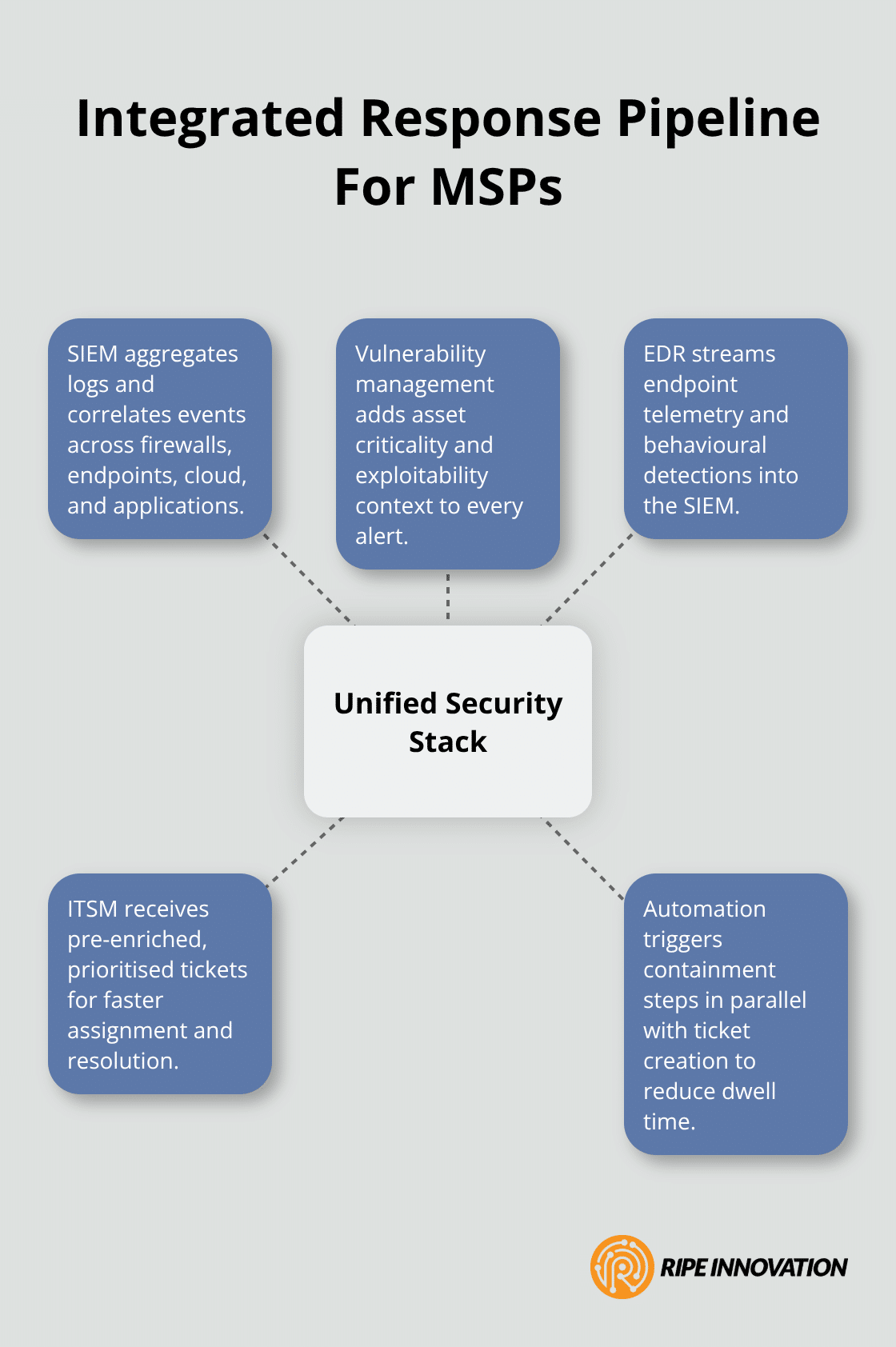
Most MSPs treat tool selection as a checkbox exercise: pick a SIEM platform, connect endpoints, deploy EDR, declare victory. This approach leaves critical gaps that sabotage your alert management strategy. The real issue isn’t finding tools-it’s assembling a cohesive stack where each component strengthens the others rather than creating isolated data silos. Your SIEM platform serves as the central nervous system, aggregating logs from firewalls, endpoints, cloud services, and applications into one searchable repository. Tenable and Qualys lead vulnerability management because their dashboards contextualize severity by asset criticality and exploitability, directly informing which alerts deserve immediate triage versus scheduled review. Yet too many MSPs implement these tools separately, forcing analysts to toggle between platforms to understand whether an alert represents genuine risk. The integration challenge intensifies when you add endpoint detection and response solutions into your stack. EDR platforms generate behavioral alerts based on endpoint activity, but without proper integration into your SIEM and ITSM workflow, these signals never reach your response team. A ransomware signature triggers on one client’s endpoint while your team remains unaware because the alert lives inside the EDR vendor’s portal rather than flowing through your centralized monitoring infrastructure.
Establish Integration Before Deployment
Integration must precede deployment, not follow it. Before selecting a SIEM platform, verify that it integrates natively with your EDR solution, cloud security tools, and identity platforms. ServiceNow offers extensive integration capabilities but demands significant customization and technical debt accumulation-most MSPs struggle to maintain complex ServiceNow deployments. Freshservice and HaloPSA provide cleaner, more maintainable alternatives that integrate well with common security tools without requiring extensive custom development. Your SIEM should automatically ingest EDR alerts and enrich them with vulnerability data from Tenable or Qualys before routing tickets to your ITSM system. This automation transforms fragmented security data into a unified incident timeline that shows which endpoint triggered an alert, what vulnerability enabled the attack, and which business-critical assets face exposure.
ConnectWise Manage and Automate excel at embedding security orchestration directly into your workflows, allowing you to build runbooks that execute containment actions in parallel with ticket creation. When phishing detection triggers, your automation should simultaneously isolate the affected mailbox, block the sender domain at the gateway, create an incident ticket, and notify your team-not wait for manual handoffs between tools.
Select Tools Based on Your Actual Workflow
Resist the temptation to implement every feature your tools offer. Most SIEM platforms provide hundreds of pre-built detection rules, yet deploying all of them guarantees alert fatigue. Instead, enable only the detections relevant to your clients’ actual risk profiles. A healthcare provider needs HIPAA-relevant alerts; a manufacturing firm needs operational technology monitoring. Customize your SIEM’s detection rules to your clients’ environments rather than accepting vendor defaults. Tenable’s vulnerability dashboards allow you to filter by asset criticality and exploitability, so configure your SIEM to suppress low-severity vulnerabilities on non-critical assets-this single adjustment eliminates thousands of worthless alerts monthly. Your EDR platform should stream behavioral alerts into your SIEM, but configure it to suppress known benign activities specific to each client’s operations. If a client’s backup software legitimately accesses thousands of files hourly, EDR behavioral rules must account for this baseline rather than triggering alerts on normal activity. This client-specific tuning requires upfront effort but pays dividends through reduced false positives and faster analyst response to genuine threats.
Connect Your Tools Into One Response Pipeline
The MSPs that dominate their markets don’t use more tools than their competitors-they integrate fewer tools more effectively. Detection, enrichment, and containment must flow seamlessly without manual intervention or alert loss. Your vulnerability management platform feeds asset criticality data to your SIEM, which uses that context to prioritize alerts before they reach your team. Your EDR solution streams endpoint telemetry into your SIEM, which correlates that data with network logs and cloud activity to detect coordinated attacks. Your ITSM system receives pre-enriched, pre-prioritized tickets that your team can act on immediately rather than spending hours investigating whether an alert matters. This integrated pipeline transforms raw security data into actionable intelligence that your team can respond to in minutes rather than hours.
Final Thoughts
Effective security alerts monitoring transforms how MSPs protect their clients and compete in an increasingly hostile threat landscape. The foundation rests on three critical pillars: tuning detection systems to eliminate false positives, automating enrichment and response workflows, and integrating your security tools into a unified pipeline that moves from detection to containment without manual handoffs. When you implement these practices, your team stops drowning in noise and starts catching threats that matter.
Your detection rules require regular refinement as client environments evolve and attackers develop new techniques. Review which alerts generated tickets that led nowhere, then adjust thresholds accordingly. Monitor your analysts’ response times and identify bottlenecks where integration gaps or manual processes slow containment. Each month, your monitoring system should become smarter and more efficient than the last.
Your clients depend on you to detect threats faster than attackers can cause damage. Evaluate your current alert volume and false positive rate, then map your existing tools to identify integration gaps between your SIEM, EDR, vulnerability management platform, and ITSM system (prioritize closing those gaps before adding new tools). Implement the strategies outlined in this guide to deliver the speed, consistency, and accountability that builds lasting client relationships and justifies ongoing security investments through proactive threat detection.