
The managed security market is reshaping how MSPs compete and grow. As client demands for protection intensify, security services have become the fastest path to recurring revenue and stronger margins.
Cybersecurity for MSP growth isn’t optional anymore-it’s the foundation of sustainable profitability. This guide shows you how to build a scalable security practice that drives real business results.
Why Managed Security Drives MSP Profitability
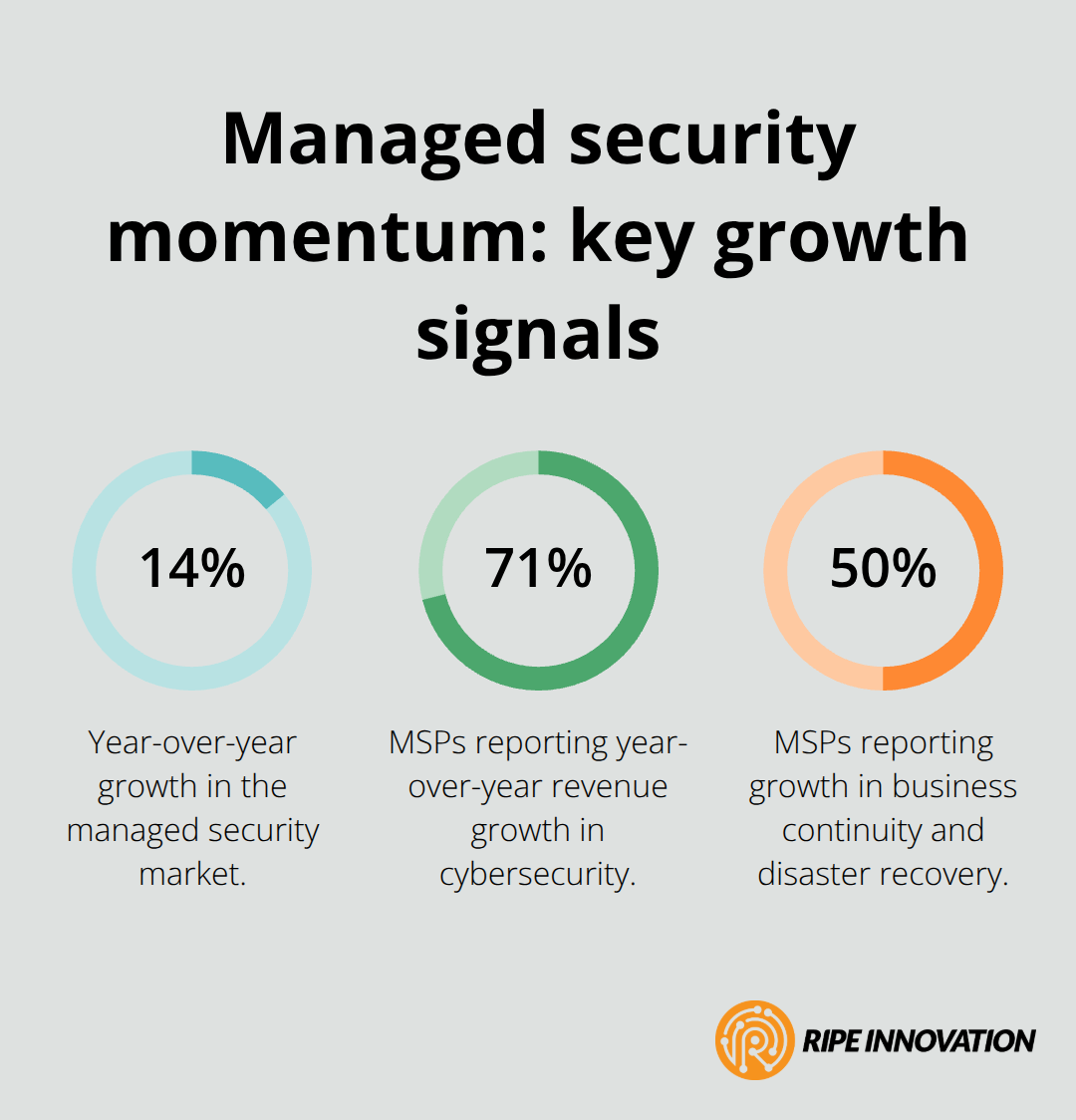
The managed security market growth of 14.4% year-over-year, reaching 106 billion dollars in 2026 from 93 billion dollars in 2025 according to Omdia, while cybersecurity product sales through MSP channels will rise by approximately 15% in 2026. This growth reflects genuine client demand driven by regulatory pressure, rising breach costs that now exceed 4 million dollars on average per incident, and tightening cyber insurance requirements. MSPs that shift from reactive IT support to proactive security services capture this expansion. The data proves it: 71% of MSPs report year-over-year revenue growth in cybersecurity, the highest among all service categories, and 50% report growth in business continuity and disaster recovery. These represent substantial improvements, not marginal gains.
Security Services Create Sticky, Predictable Revenue
Security services deliver recurring monthly revenue with predictable client retention because once a client depends on your threat detection and incident response, switching costs become prohibitive. Unlike infrastructure services where clients constantly hunt for cheaper alternatives, security becomes embedded in their operations. The margins tell the story too. Traditional per-user helpdesk models are heavily commoditized, forcing MSPs to compete on price and compress profits. Security services command premium pricing because clients understand the financial and operational consequences of a breach. Your security offering protects their revenue, their reputation, and their regulatory standing-services they will pay for consistently.
Insurance Requirements Lock Clients Into Your Services
Cyber insurance underwriters now mandate minimum security standards as baseline requirements for coverage, meaning your security service directly qualifies clients for insurance eligibility and potentially lower premiums. This creates a stickiness that helpdesk support simply cannot match. When you prove that your threat monitoring, access controls, and compliance reporting reduce breach risk and insurance costs, clients view you as a strategic partner, not a vendor. The 2023 ConnectWise MSP Threat Report analyzed over 440,000 incidents and highlighted rising supply chain attacks on MSPs themselves, pushing clients to demand that their MSP partners operate at higher security standards. This expectation transfers directly into your service offerings. Clients increasingly require their MSPs to demonstrate strong security posture, creating a virtuous cycle: you implement security for yourself, then package those same capabilities for clients, and they trust you because you practice what you sell.
The Path Forward: Building Your Security Practice
The foundation for MSP growth rests on recognizing that security services operate under fundamentally different economics than traditional IT support. Clients will not shop around once they trust you with their threat detection and compliance obligations. The next section explores the specific security services that deliver the highest profitability and client impact, and how to build these offerings without the heavy infrastructure investment that once deterred smaller MSPs from entering the security market.
What Security Services Deliver the Strongest Margins
Endpoint protection, network security, and vulnerability assessments represent the three pillars of MSP security profitability because they address distinct threat vectors while building on each other to create comprehensive client coverage. Endpoint protection and threat detection stop malware, ransomware, and fileless attacks at the device level, which matters because endpoints remain the primary attack surface for most organizations. Ransomware attacks now lock down entire networks within hours, making detection speed critical.
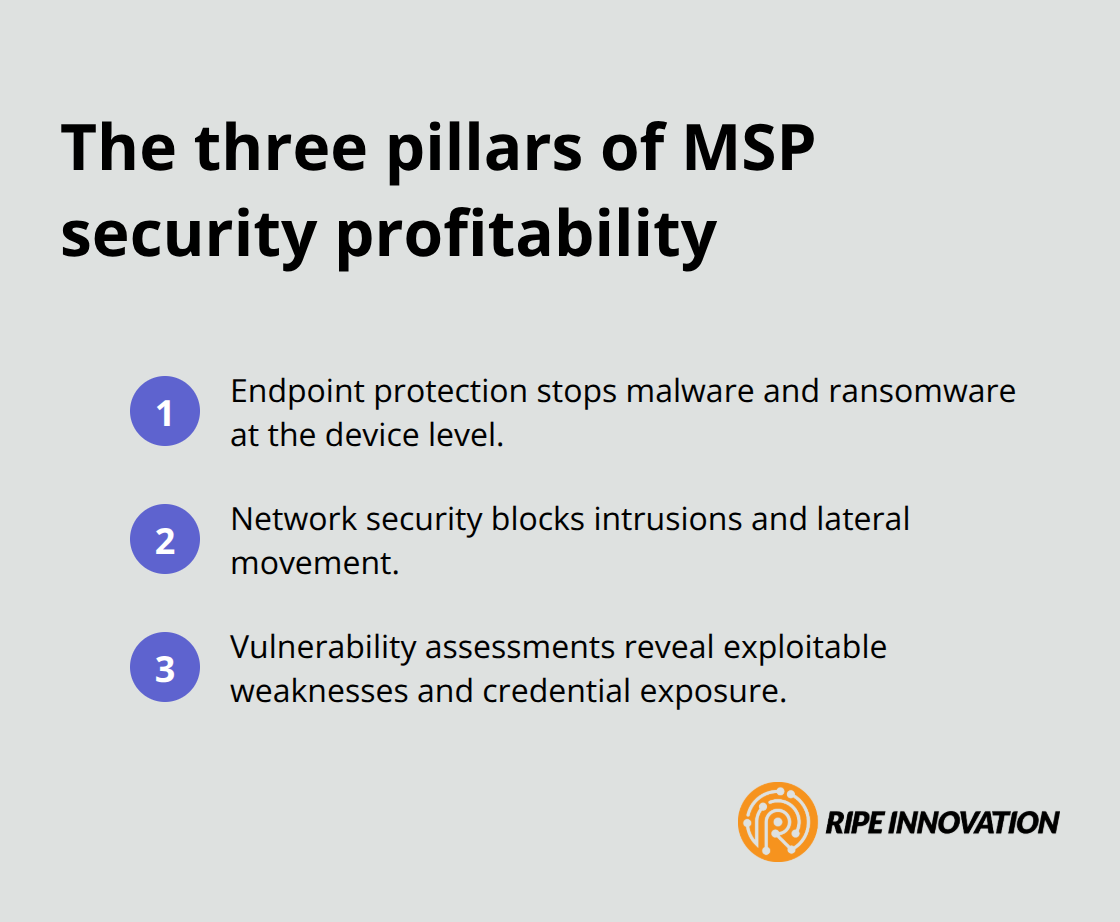
Network security and firewall management prevent lateral movement and external intrusions by monitoring traffic patterns and blocking malicious connections before they reach sensitive systems. Vulnerability assessments paired with dark web monitoring create the intelligence layer that identifies what attackers can exploit and whether your client’s credentials already circulate on underground forums. Together, these three services form a complete defense strategy that clients cannot ignore. The profitability advantage lies in their complementary nature: once you deploy endpoint protection, clients naturally ask how to secure their networks; once you monitor networks, they need to know what vulnerabilities exist; once you find vulnerabilities, dark web monitoring reveals whether criminals already target them. This progression creates natural upsell paths and justifies premium pricing because each service multiplies the value of the others.
Endpoint Protection Generates Immediate Threat Intelligence
Endpoint protection platforms now use behavioral analysis and AI to detect zero-day exploits that traditional signature-based antivirus misses entirely. This matters for your margins because clients will pay substantially more for a solution that catches threats no other tool detects. Modern endpoint solutions also provide forensic data that accelerates incident response, showing exactly which files attackers accessed, what data moved, and how the attacker established persistence. This forensic capability transforms your role from reactive responder to strategic investigator, justifying higher retainers. Pricing typically ranges from 3 to 8 dollars per endpoint monthly depending on feature depth, but when you bundle threat detection with incident response services, clients accept pricing closer to 12 to 15 dollars per endpoint because they understand the cost of a breach exceeds 4 million dollars on average.
Network Security Requires Constant Tuning, Not Just Deployment
Firewalls and network monitoring only generate value when you properly configure them and continuously adjust them to reflect changing threat patterns and new client systems. This creates a recurring service opportunity that infrastructure deployments never provide. Most MSPs deploy firewalls but fail to optimize rule sets, leaving clients with either overly restrictive policies that block legitimate traffic or overly permissive policies that defeat the firewall’s purpose. Offering managed firewall tuning and threat log review as a separate line item allows you to charge 500 to 1500 dollars monthly for ongoing optimization, which requires only 5 to 10 hours of skilled technician time monthly once initial configuration completes. This service also provides the data foundation for compliance reporting, since regulators now expect documented evidence of network monitoring and threat detection. Network breaches often remain undetected for months, giving attackers time to move laterally and extract large datasets.
Vulnerability Assessments Convert Risk Into Measurable Business Outcomes
Vulnerability scanning tools generate thousands of findings, but clients struggle to prioritize remediation when budgets remain tight. Your value lies in translating raw scan data into business language: which vulnerabilities actually threaten their operations, what remediation timeline makes sense, and how fixes align with their insurance requirements. Quarterly vulnerability assessments priced at 1500 to 3000 dollars per engagement often lead to remediation service contracts worth 5000 to 10000 dollars because clients see the specific risks you identified. Dark web monitoring adds urgency by confirming whether client credentials or data already appear in breach databases, transforming abstract risk into concrete evidence that action is needed now, not eventually. These three service pillars work together to create a compelling security narrative that justifies premium pricing and builds client loyalty-but only when you position them strategically to address the specific threats your clients face most.
Building Security Without the Capital Burden
Most MSPs avoid security services because they assume they need to hire specialized security staff, invest in expensive monitoring infrastructure, and accept long-term vendor commitments that lock them into rigid pricing. This assumption is wrong. The fastest path to security revenue runs through partnerships with established vendors who handle the technical heavy lifting while you own the client relationship and pricing. Partner-first resellers have structured partnerships specifically for MSPs, offering flexible, commitment-free models with transparent pricing and full technical support included. This approach eliminates the infrastructure investment entirely.
Eliminate Infrastructure Investment Through Vendor Partnerships
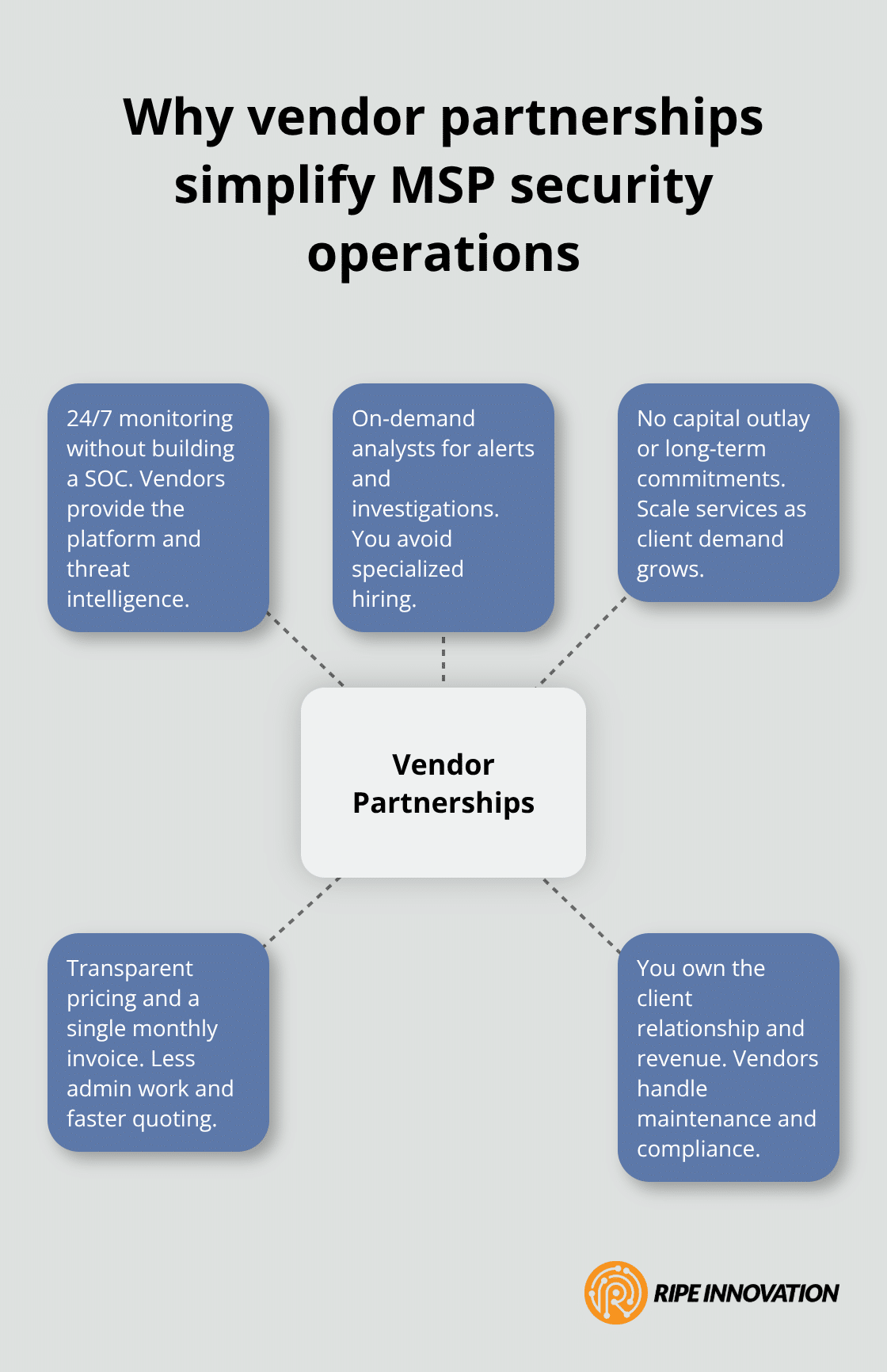
Instead of building your own security operations center, you leverage vendor platforms and tap their 24/7 monitoring capabilities. Instead of hiring expensive security analysts, you use vendor resources to respond to alerts and investigate incidents. The economics shift dramatically: you deploy endpoint protection, firewall management, and vulnerability scanning without capital outlays, without hiring cycles, and without the risk of overbuilding capabilities that clients do not yet need. Vendors handle the platform maintenance, threat intelligence updates, and regulatory compliance documentation. You handle the client relationship, the service delivery coordination, and the revenue collection. This division of labor lets smaller MSPs compete directly with larger firms because you offer the same security capabilities without the overhead burden that makes enterprise vendors unable to serve mid-market clients profitably.
Start Small and Expand as Client Demand Grows
The second critical advantage is flexibility in service packaging. Avoid long-term commitments that force you to predict client security needs 12 or 24 months in advance. Month-to-month partnerships let you start with endpoint protection only, prove value over 60 days, then expand to network security and vulnerability assessments once clients see measurable threat reduction and insurance cost savings. This staged approach reduces sales friction because clients commit to smaller initial investments rather than comprehensive security programs. It also protects your cash flow because you scale service delivery exactly as client demand grows.
Simplify Operations With Transparent, Single-Invoice Billing
Vendors who offer commitment-free terms with single monthly billing eliminate the complexity of managing multiple vendor invoices and contract renewal dates. You receive one bill, one support contact, and transparent pricing with no surprise fees. This simplicity matters operationally: your accounting team spends less time managing vendor relationships, your technicians focus on client delivery rather than contract compliance, and your sales team can quote security services in minutes rather than weeks.
Choose Partners Built for MSP Success
Start with vendors and partners who already serve MSPs at scale. They understand your business model, they have built-in MSP support resources, and they price their services knowing that MSPs operate on tighter margins than enterprises. Avoid vendors who position themselves as enterprise-first and treat MSPs as aftermarket channels. Those relationships invariably result in poor support, inflexible pricing, and long-term contracts that trap you when client needs change. Partner-first resellers like those offering Sophos, Watchguard, Crowdstrike, Malwarebytes, DNSfilter, Webroot, SentinelOne, Bitdefender, dark web scanning, and vulnerability assessments have delivered flexible, commitment-free partnerships with transparent pricing and full sales and technical support since 2011, demonstrating that MSP-focused vendors exist and thrive in this space.
Final Thoughts
The managed security market’s 14.4% year-over-year growth reflects a fundamental shift in how clients evaluate their MSP partnerships. Security has become the primary driver of recurring revenue, client retention, and competitive differentiation in an increasingly crowded market. MSPs that recognize this shift and act decisively will capture disproportionate growth while those that delay will find themselves competing on price and margin compression.
Cybersecurity for MSP growth succeeds when you stop viewing security as a separate business unit requiring massive capital investment and specialized hiring. The vendor partnership model eliminates that barrier entirely-you can launch endpoint protection, network security, and vulnerability assessments within weeks using established platforms, transparent pricing, and commitment-free terms. Your clients receive enterprise-grade threat detection and compliance reporting while you capture recurring revenue with margins that dwarf traditional helpdesk services.
The path forward requires three concrete actions: audit your current client base to identify which organizations face the highest breach risk or insurance pressure, select a vendor partner aligned with MSP success rather than enterprise-first positioning, and package your initial security offering around the specific threats your target clients face most. Move forward with managed security and launch with one service to prove measurable value within 60 days, then expand to the full security stack as client confidence grows.